
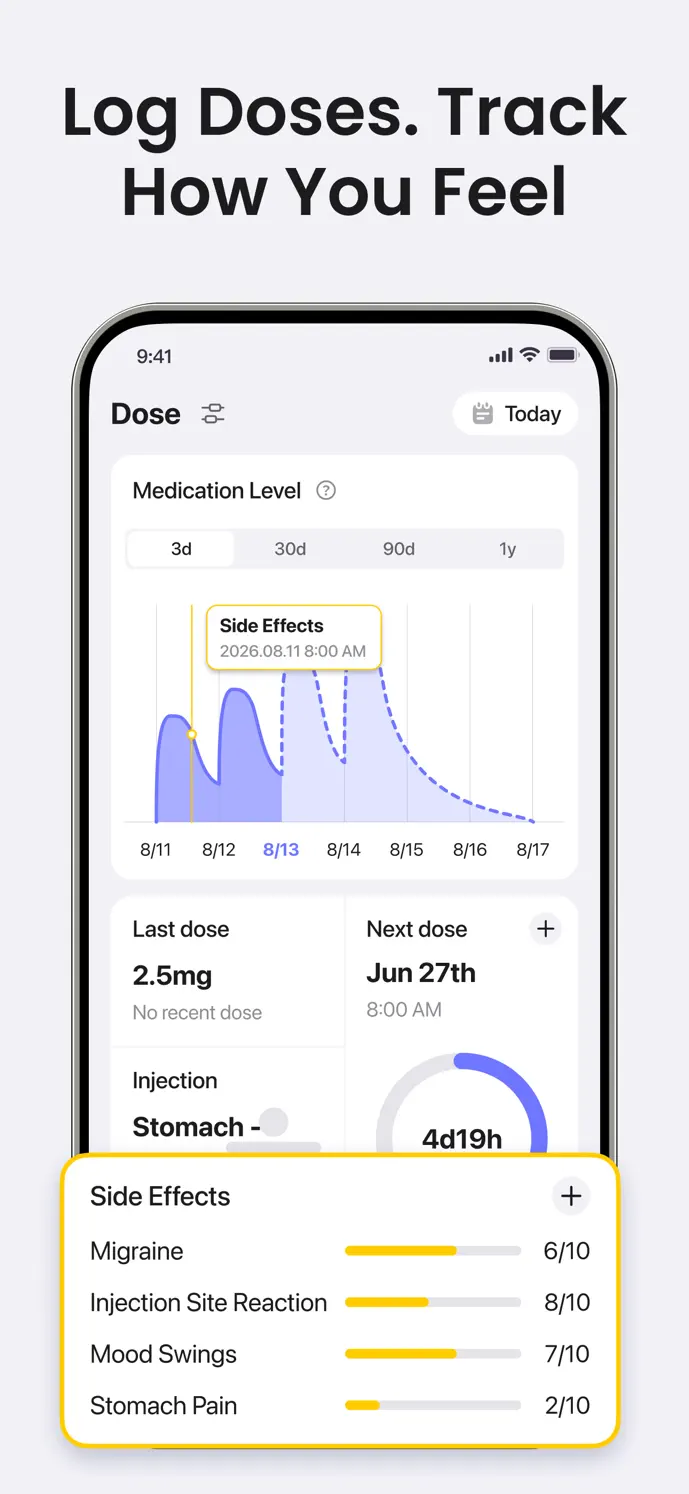
At a glance
- Based on recorded doses
- Mathematical estimate
- Informational use
The information that shapes the curve
Only the records available to the app can contribute. A missing injection, incorrect unit, or mistyped date can affect the displayed history.
| Input | Why it matters |
|---|---|
| Medication selection | Determines which estimation model is used |
| Dose and unit | Determines the amount represented by the entry |
| Date and time | Determines where the recorded dose sits on the timeline |
| Earlier injection records | Contribute to the combined estimate at later times |
A model of changes over time
The estimation models represent absorption and elimination over time, then combine contributions from recorded injections. Model assumptions vary by medication selection. The app includes a “Basis of estimation” explanation with references for supported models.
A reference explains background information used for an estimate. It does not establish that GlowBack’s specific implementation has been clinically validated for you. The chart does not use a personal blood sample or a direct measurement of your metabolism.
What the chart cannot determine
Use your prescribed plan and professional advice for treatment decisions. A low-looking or high-looking part of the curve is not an instruction to change that plan.
- Your actual blood concentration at a particular time.
- Whether a dose is safe or effective for you.
- Whether you should change, delay, repeat, or increase a dose.
- Whether a symptom was caused by a medication.
- A weight-loss outcome or a guaranteed date for reaching a goal.
Why an estimate can change after editing a record
When you change a recorded amount or time, the app recalculates that entry’s contribution. Deleting an entry removes it from the history used by the estimate. These changes can affect more than one point on the chart.
If the curve looks unexpected, start by checking the medication, dose, unit, and time of your entries. Keep the record accurate rather than adjusting entries to make the chart look a certain way.
Medication and feature coverage
Logging support and estimation support are different. The presence of a medication in the picker does not establish that it has a uniquely validated model. Injectable estimates should not be treated as estimates for oral medication records.
Available chart views depend on your app version, platform, and plan. If an estimate still seems inconsistent after checking the records, contact the GlowBack team with the app version and a description of what you expected to see.
A little more clarity
Common questions
Is the displayed level a blood-test result?
No. It is calculated from recorded injections and model assumptions. It is not a measured blood concentration or a clinical test result.
Does the curve predict my side effects?
No. Symptom entries are your observations. Displaying them near a curve provides timing context, but does not predict symptoms or establish their cause.
Should I take another dose when the curve falls?
Do not use the curve to decide your dose or timing. Follow your medication instructions and your healthcare professional’s treatment plan.